Matcha during pregnancy: how much can you have?
19-05-2026 · 25 min read
Reading time: ±16 minutes - Last updated: August 2026
Yes, you may drink matcha while pregnant, provided you stay within the caffeine guidelines. The RIVM (Dutch National Institute for Public Health and the Environment) and the Voedingscentrum (Netherlands Nutrition Centre) advise pregnant women to consume no more than 200 mg of caffeine per day. A cup of matcha contains approximately 64 mg of caffeine, which falls well within that limit. This even leaves room for a piece of dark chocolate or a glass of cola if you would like.
But there are nuances. Besides caffeine, matcha also contains EGCG (a catechin) that can affect the absorption of folic acid. And as with everything during pregnancy: always consult your midwife or gynecologist if you are in doubt. In this article, we honestly explain the facts, the guidelines, and the precautions, including the topics that most other articles on this subject skip.
Important: this is not medical advice
This article is for informational purposes and is based on publicly available guidelines from the RIVM, the Voedingscentrum, and scientific sources. It does not replace advice from your midwife, gynecologist, or general practitioner. Always discuss changes in your diet with your healthcare provider.
The caffeine guideline: what do the RIVM and the Voedingscentrum say?
The RIVM and the Voedingscentrum advise a maximum of 200 mg of caffeine per day during pregnancy. The WHO uses the same guideline. A cup of matcha (64 mg) fits well within that limit.
The guideline of a maximum of 200 mg of caffeine per day is based on research associating higher intakes with a slightly increased risk of low birth weight (CARE Study Group, British Medical Journal, 2008). No proven risks have been found with an intake below 200 mg per day.
A cup of matcha (2 grams of powder) contains approximately 64 mg of caffeine. That is 32% of the daily limit. You can therefore drink a cup of matcha and still have 136 mg of caffeine allowance left for other sources.
How much caffeine is in matcha compared to other drinks?
Matcha contains 64 mg of caffeine per cup. That is less than filter coffee (95 mg), comparable to an espresso (63 mg), and more than regular green tea (25 to 35 mg).
|
Drink |
Caffeine |
Still fits (up to 200 mg)? |
|
Matcha (1 cup, 2g) |
64 mg |
Yes, 136 mg left |
|
Filter coffee (1 cup) |
95 mg |
Yes, but only 105 mg left |
|
Espresso (1 shot) |
63 mg |
Yes, 137 mg left |
|
Green tea (1 cup) |
25-35 mg |
Yes, 165-175 mg left |
|
Black tea (1 cup) |
47 mg |
Yes, 153 mg left |
|
Cola (330 ml) |
32 mg |
Yes, 168 mg left |
|
Dark chocolate (30g) |
20 mg |
Yes, 180 mg left |
|
Red Bull (250 ml) |
80 mg |
Yes, but only 120 mg left |
Note: add up all caffeine sources in your day. If you have a matcha in the morning (64 mg), a cup of black tea in the afternoon (47 mg), and a piece of dark chocolate after dinner (20 mg), you are at 131 mg, still well within the limit. For the full explanation of caffeine in matcha outside the pregnancy context, read how much caffeine is in matcha.
Matcha vs coffee during pregnancy: which is smarter?
Matcha contains less caffeine than coffee (64 mg vs 95 mg), provides more stable energy thanks to L-theanine (no peak and crash), and is less acidic (pH 7-8 vs 4.5-5). For pregnant women with morning sickness, the lower acidity can be a benefit.
|
Matcha |
Filter coffee |
|
|
Caffeine |
64 mg |
95 mg |
|
% of daily limit |
32% |
48% |
|
L-theanine |
40-60 mg (buffers) |
0 mg |
|
pH value |
7-8 (neutral) |
4.5-5 (acidic) |
|
Energy curve |
Gradual, 4-6 hours |
Peak and crash, 2-3 hours |
|
Nausea risk |
Lower (less acidic) |
Higher (more acidic) |
|
Antioxidants (EGCG) |
60-100 mg |
Minimal |
Many pregnant women switch from coffee to matcha because it contains less caffeine, provides more stable energy, and causes less nausea thanks to its neutral pH. The L-theanine provides a calm, focused feeling without the jitters that coffee sometimes gives. Read the full comparison in matcha versus coffee.
Things to watch out for: EGCG and folic acid
EGCG (the catechin in matcha) can affect the absorption of folic acid. The practical solution: do not drink matcha at the same time as your folic acid supplement; wait at least 1 to 2 hours between them.
This is the most important nuance. EGCG can inhibit the activity of the enzyme dihydrofolate reductase, which is involved in the conversion of folic acid to its active form (Navarro-Perran et al., International Journal of Food Sciences and Nutrition, 2007). Folic acid is crucial in the first trimester for the development of the baby's nervous system.
The practical solution is simple: take your folic acid supplement at a different time than you drink your matcha. For example, take your folic acid with breakfast and drink your matcha mid-morning, or vice versa. With 1 to 2 hours in between, there is no problem.
Important: this applies not only to matcha but to all green tea. It is a property of EGCG, not specific to matcha.
Why your caffeine metabolism changes during pregnancy
As your pregnancy progresses, your body breaks down caffeine more slowly. In the third trimester, this can take two to three times longer than normal.
A detail missing from most articles about matcha and pregnancy: the 200 mg guideline is an average, but your own caffeine metabolism changes during pregnancy. In the first trimester, your body breaks down caffeine at about the same rate as before. From the second trimester, this process slows down noticeably, and in the third trimester, the breakdown can take two to three times longer than in a non-pregnant woman. This is because pregnancy hormones slow down the activity of the liver enzyme CYP1A2, which is responsible for breaking down caffeine.
Practically, this means that the same amount of matcha you tolerated effortlessly in the first trimester will remain in your system longer in the third trimester and may thus have an effect for longer, for example, on your sleep. This is also the reason why the trimester-by-trimester table later in this article advises drinking it mainly in the morning during the third trimester.
There is another reason to be alert here: an unborn baby can hardly break down caffeine themselves because the necessary liver enzymes are not yet fully developed. Caffeine that passes through the placenta therefore remains present in the baby's system longer than in the mother's. This is one of the reasons why the guideline uses a clear maximum instead of 'as much as you can tolerate yourself'.
What science is not yet certain about
Most guidelines use 200 mg per day as a safe upper limit, but not all researchers agree with this. Based on caution, some advise avoiding caffeine entirely during pregnancy.
It is fair to mention that there is no complete scientific consensus. A review article in the Dutch Journal of Medicine (Nederlands Tijdschrift voor Geneeskunde) discusses an analysis in BMJ Evidence-Based Medicine in which a researcher, based on the most important studies of the past twenty years, advises that women who are pregnant or trying to get pregnant should avoid caffeine entirely (NTvG, 2020, https://www.ntvg.nl/artikelen/cafeine-tijdens-de-zwangerschap). That advice is based on observational research, which means that a causal link has never been fully demonstrated, but it shows that 200 mg is not seen by everyone as the definitive, risk-free limit.
Furthermore, apart from the caffeine discussion, there is scientific attention for polyphenols (a group of substances that also includes the catechins in matcha) and their potential influence on the Ductus Arteriosus, a blood vessel in the unborn baby that normally only closes after birth. The Royal Dutch Organisation of Midwives mentions this as a reason to be cautious with larger amounts of green tea, especially in the last trimester. This research is still in an early stage and is not specific to matcha, but for polyphenols in green tea in general.
What does this mean for you? That depends on how cautious you want to be yourself. The 200 mg guideline from the RIVM and the Voedingscentrum is the official Dutch standard and is used by most healthcare providers. If you prefer to be extra careful, consuming less than a cup a day, or switching to a caffeine-free alternative in the last trimester, is also a perfectly reasonable choice. This is exactly the kind of trade-off you should discuss with your midwife, as they know your complete medical situation.
Iron absorption: why timing is just as important as quantity
The tannins in matcha and other tea can reduce the absorption of non-heme iron (plant-based iron) by up to 60% if you drink it around a meal. Therefore, drink matcha between meals.
Iron deficiency is more common during pregnancy because your body is producing more blood and the baby is being provided for through you. This topic does not get much attention in most articles about matcha and pregnancy, even though it is relevant: the tannins in matcha and other tea can significantly reduce the absorption of non-heme iron—the form of iron that comes from plant-based sources like spinach, legumes, and whole-grain products—when consumed at the same time as a meal.
The solution is simple and requires no adjustment in quantity: drink your matcha at least an hour before or after a meal, rather than with it. Preferably combine your iron-rich meal with something rich in vitamin C, such as a slice of lemon or a glass of orange juice, as that promotes the absorption of non-heme iron. If you use an iron supplement, for example because your midwife has advised it, then also keep at least an hour of space between your matcha and your supplement.
By the way, this advice applies not only to matcha but to tea in general, and is extra relevant during pregnancy because your iron requirement is higher than normal. For more on this subject, also outside of pregnancy, read matcha and iron absorption.
Matcha and fertility: relevant if you are trying to get pregnant
There is no strong evidence that moderate matcha consumption affects fertility, but the same caffeine guideline (200 mg per day) is also recommended for women trying to get pregnant.
If you are not yet pregnant but are trying, the same considerations apply as during the pregnancy itself. Some research suggests that a very high caffeine intake (well above 200 mg per day, think 4 to 5 cups of coffee) may be associated with a longer time to conception, but with moderate consumption, such as a cup of matcha per day, that link has not been demonstrated. If you are trying to conceive, it is reasonable to follow the same 200 mg guideline that applies during pregnancy, so you do not have to change your habits from the first day of a positive test.
How does matcha compare to other pregnancy-safe teas?
Rooibos tea and most fruit teas are naturally caffeine-free. Some herbal teas, such as licorice tea, are actually advised against during pregnancy.
Matcha does not stand alone: most pregnant women drink a mix of beverages throughout the day. Rooibos tea is naturally caffeine-free and a safe alternative if you have already used your caffeine allowance or prefer not to drink any more caffeine that day. Most fruit teas are also caffeine-free, although it is smart to check the label, as some blends contain added green or black tea.
Be more cautious with herbal teas that make medical claims, such as "detoxifying," "cleansing," or "menstruation inducing." Licorice tea is generally advised against during pregnancy. If you are unsure about a specific herbal tea, ask your midwife or pharmacist for advice, because the effect of herbs on pregnancy is not as well researched for every herb as it is for caffeine.
Matcha has a clear advantage over these alternatives if you consciously want caffeine, but in a gentler, more stable way than coffee: the combination of caffeine and L-theanine ensures fewer peaks and less chance of restlessness than a comparable amount of caffeine from coffee.
5 tips for matcha during pregnancy
Maximum 1 cup per day, not at the same time as folic acid or iron supplements, choose ceremonial grade, add up all your caffeine sources, and consult your midwife.
1. Maximum 1 cup per day (2 grams). This keeps you at 64 mg of caffeine, well within the 200 mg limit. Did you also drink coffee that day? Add it up.
2. Do not drink matcha at the same time as your folic acid supplement. Keep at least 1 to 2 hours between them so as not to influence the absorption of folic acid.
3. Choose ceremonial matcha. Ceremonial matcha from the first harvest contains more L-theanine (calming) and fewer tannins (stomach-irritating) than culinary grade. During pregnancy, your stomach is often more sensitive, so quality makes an extra difference. Customers of Unmatched Matcha with a sensitive stomach indicate they have fewer issues than with other matcha.
4. Drink matcha between meals, not with them, so the tannins do not hinder your iron absorption. Add up all your caffeine sources: coffee, tea, cola, chocolate, energy drinks all count. Keep a simple daily log if you are uncertain.
5. Consult your midwife. This article is for informational purposes. Your midwife knows your situation, your medical history, and your specific needs. Discuss it if you are in doubt, or if you prefer to follow a stricter approach than the standard guideline.
Can you drink matcha while breastfeeding?
Yes, the same guideline applies: a maximum of 200 to 300 mg of caffeine per day. Approximately 1% of the ingested caffeine ends up in breast milk. For most women, one cup of matcha per day is not a problem.
During breastfeeding, the caffeine guideline is slightly more flexible (200 to 300 mg per day, depending on the source). Approximately 1% of ingested caffeine ends up in breast milk (Berlin et al., Seminars in Fetal & Neonatal Medicine, 2009). With a cup of matcha (64 mg), that is about 0.6 mg of caffeine that your baby receives, a negligible amount.
Note, however: some babies are more sensitive to caffeine than others, particularly premature babies, whose livers break down the substance even more slowly than those of full-term babies. If you notice that your baby is more restless on days you drink matcha, reduce the amount or consult your midwife.
Per trimester: what changes?
|
Trimester |
Point of focus |
Matcha advice |
|
1st (wks 1-13) |
Folic acid crucial, nausea |
Do not consume simultaneously with folic acid; matcha may reduce nausea (less acidic than coffee) |
|
2nd (wks 14-27) |
Most stable period, iron needs increase |
1 cup of matcha per day is fine for most women; drink between meals |
|
3rd (wks 28-40) |
Baby grows quickly, sleep becomes harder, caffeine breakdown slows down significantly |
Drink matcha before 2:00 PM, consider less than 1 cup if you are sensitive to caffeine |
As explained earlier in this article, your body breaks down caffeine two to three times slower in the third trimester than normal. Therefore, it is advised to drink it even earlier in the day during the final trimester than in the first two.
How does the Dutch guideline compare to international recommendations?
The Netherlands, the United Kingdom, and the American ACOG all use 200 mg of caffeine per day as an upper limit. The WHO is slightly more flexible at 300 mg.
The RIVM and the Voedingscentrum (Netherlands Nutrition Centre) are not alone in their 200 mg caffeine per day recommendation. The British National Health Service (NHS) and the American College of Obstetricians and Gynecologists (ACOG) also use the same 200 mg per day threshold. The European Food Safety Authority (EFSA), which provides advice for the entire European Union, also arrives at 200 mg. Only the World Health Organization (WHO) maintains a slightly more flexible margin with less than 300 mg per day.
This international consensus around 200 mg is reassuring: it is not a uniquely Dutch caution, but a broadly supported international consensus based on overlapping research. ACOG explicitly concludes that moderate caffeine consumption (less than 200 mg per day) does not appear to be a major contributing factor to miscarriage or preterm birth, although the association with fetal growth restriction remains unclear according to ACOG (ACOG, Committee Opinion, https://www.acog.org/clinical/clinical-guidance/committee-opinion/articles/2010/08/moderate-caffeine-consumption-during-pregnancy).
The half-life of caffeine—the time your body needs to break down half of the consumed amount—is around 5 hours outside of pregnancy. Various sources show that during pregnancy, particularly in the third trimester, this can increase to somewhere between 10 and 18 hours. This aligns with what was explained earlier in this article about delayed breakdown in later trimesters and underscores why it is advised to be more cautious with caffeinated drinks like matcha later in the day.
Common misconceptions about matcha and pregnancy corrected
There are quite a few persistent misconceptions circulating about matcha and pregnancy. Below are the most common ones, alongside the facts.
Misconception 1: matcha is caffeine-free because it is tea
This is one of the most common misunderstandings. Matcha does indeed contain caffeine, and even more per serving than loose green tea, because with matcha you consume the entire leaf instead of just the infusion. The 64 mg per cup is real and counts fully toward your daily caffeine budget.
Misconception 2: a little bit of caffeine is inherently harmful
The official 200 mg per day guideline exists precisely because moderate caffeine intake, contrary to what some people believe, is not linked to proven risks. Fear of every drop of caffeine is unnecessary as long as you stay within the guideline. It is about the total amount per day, not complete abstinence.
Misconception 3: green tea is inherently a safer alternative to coffee
Green tea does contain less caffeine than coffee, but "less" does not mean "none." Three to four cups of loose green tea per day already bring you close to the 200 mg limit, and the EGCG-folic acid interaction applies to all green tea, not just matcha. It is therefore not a free pass for unlimited consumption.
Misconception 4: if it is natural, it is automatically safe during pregnancy
This applies not only to matcha but to food in general during pregnancy. Some natural herbs and plants are actually advised against during pregnancy, while certain processed products in small quantities are not a problem. "Natural" says nothing about safety during pregnancy; the actual composition and dosage do.
Misconception 5: drinking slightly more than recommended once is immediately dangerous
The 200 mg guideline is a cautious, structural upper limit for your average daily intake, not a hard threshold that causes immediate risks if exceeded. A single day slightly above the recommendation, for example due to an extra cup at a party, is no reason for panic. Consistently and structurally being well above the guideline is what requires attention.
Signs that you might be getting too much caffeine
Heart palpitations, difficulty falling asleep, restlessness, or shakiness may indicate that you have had too much caffeine that day, even if you thought you remained under 200 mg.
Because caffeine sensitivity varies from person to person, and because your sensitivity can change during pregnancy, it is useful to know which signs might indicate excessive caffeine consumption on a given day. Watch out for heart palpitations or a noticeably faster heartbeat, difficulty falling asleep even when you go to bed on time, a restless or shaky feeling, and unusual irritability.
If you recognize one or more of these signs on a day you have had more caffeine than usual, tally up your total intake for that day (coffee, tea, soda, chocolate, energy drinks) and reduce it back to your usual amount the next day. If the symptoms persist, even with normal intake, discuss this with your midwife, as it could have other causes unrelated to caffeine.
What else is in matcha that is relevant during pregnancy?
Besides caffeine and EGCG, matcha contains iron, calcium, and vitamin A, substances that are especially important during pregnancy, although the amount per cup is too small to serve as a complete nutritional source.
Matcha is often discussed only from the perspective of what to avoid (caffeine, EGCG interaction with folic acid and iron), but it also contains nutrients that are relevant during pregnancy. A cup of matcha provides a small amount of iron, calcium, and vitamin A, alongside the well-known antioxidants. The quantities per cup are too small to count as a serious source of these nutrients, so matcha does not replace a healthy diet or prenatal supplements, but it is not a hollow drink without any nutritional value.
Additionally, the L-theanine in matcha has a calming effect on the nervous system, which some pregnant women find pleasant during a period when stress and sleep problems occur more frequently. This effect is not the same as a sedative or anti-anxiety medication, but many users describe it as a calm, focused feeling without grogginess.
Matcha latte during pregnancy: milk and sweetener choices
The matcha itself does not change by making a latte out of it, but the milk and sweetener you add are relevant during pregnancy.
A matcha latte contains the same amount of matcha, and therefore the same 64 mg of caffeine, as a pure cup of matcha. What does change is the milk and any sweetener you add. Pasteurized cow's milk and most plant-based milks, such as oat milk, almond milk, and soy milk, are safe during pregnancy. Avoid raw, unpasteurized milk, regardless of the source, due to the risk of listeria.
Regarding sweeteners, there is no specific pregnancy ban on regular sugar, honey, or maple syrup in the small quantities used in a latte. Some pregnant women choose to limit added sugar due to the risk of gestational diabetes, especially in the second and third trimesters when that risk increases. Good quality ceremonial matcha already has a naturally softer, less bitter taste, meaning you need less sweetener to enjoy it anyway.
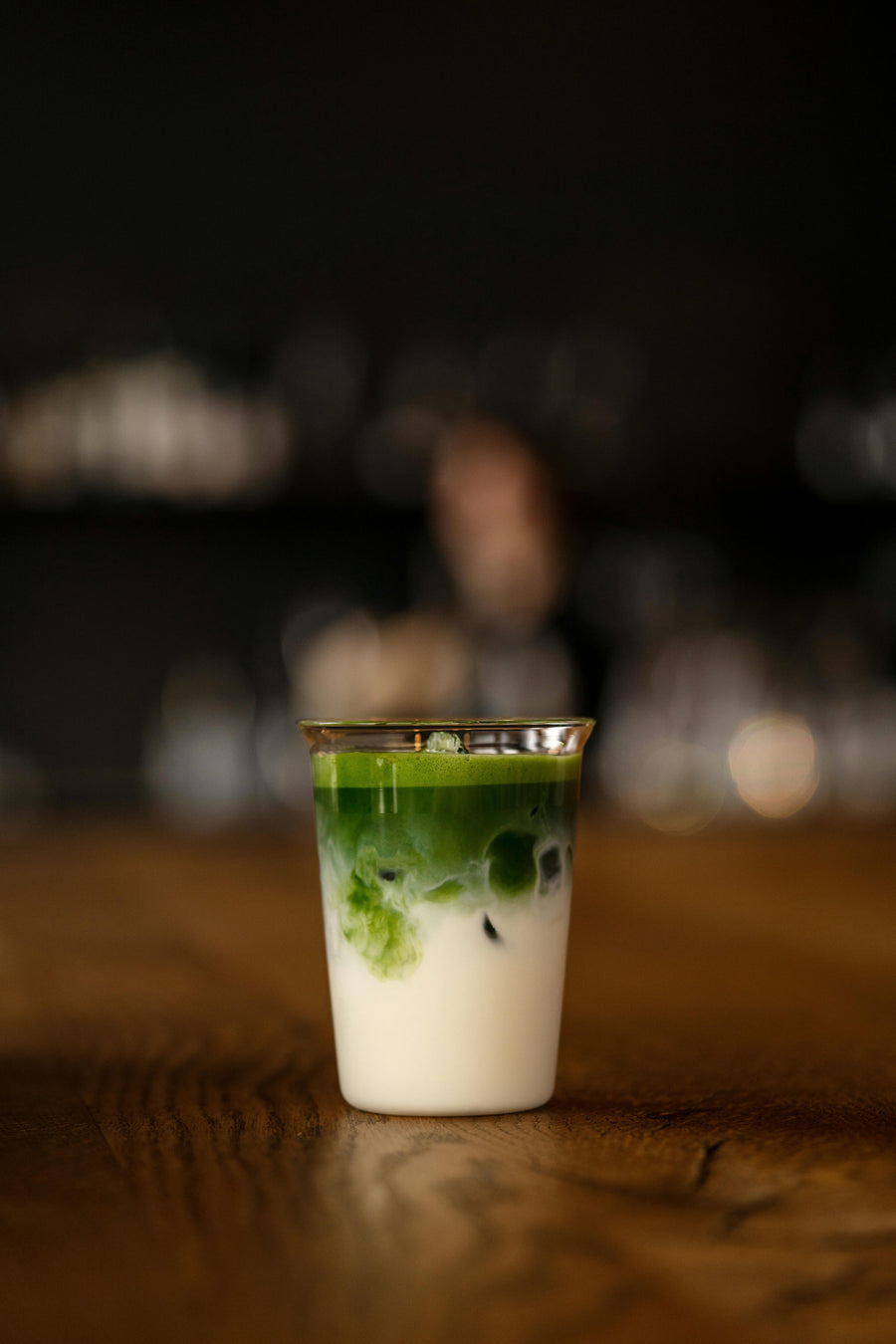
Would you like an iced matcha latte in the summer? That is perfectly fine; the caffeine content does not change with temperature. Just make sure, as with a hot preparation, not to drink it at the same time as your folic acid or iron supplement.
Why quality carries extra weight during pregnancy
A more sensitive digestive system and a lower tolerance for bitterness make quality differences between matcha during pregnancy more noticeable.
Outside of pregnancy, you notice the difference between ceremonial and culinary matcha primarily in taste. During pregnancy, that difference can also manifest physically. Many pregnant women experience a more sensitive digestive system, with a higher risk of nausea or heartburn. Culinary or low-quality matcha generally contains more tannins—the group of substances that also plays a role in iron absorption and that can cause irritation more quickly in sensitive stomachs.
Ceremonial matcha from the first harvest, such as Unmatched Matcha from Kagoshima, naturally contains fewer tannins and more L-theanine than later harvests or culinary grades. This makes it not only softer in taste but also more pleasant for the stomach for many pregnant women. Moreover, pay attention to transparency: a reliable supplier is open about origin, harvest, and grinding method, rather than just placing the word "ceremonial" on the label without further substantiation. Read more about what to look for when buying matcha in general in the complete buying guide for the best matcha.
Frequently asked questions
Can you drink matcha if you are pregnant?
Yes, provided you stay within the caffeine guideline. The RIVM and the Voedingscentrum advise a maximum of 200 mg of caffeine per day during pregnancy. A cup of matcha contains approximately 64 mg of caffeine, which is well within that limit. Consult your midwife if you are in doubt.
How much matcha can you drink during pregnancy?
A maximum of 1 cup per day (2 grams of matcha, 64 mg of caffeine). This leaves room for other caffeine sources. Always add up all your caffeine sources for that day (coffee, tea, soda, chocolate). Also read how much matcha is generally healthy per day.
Is matcha safer than coffee during pregnancy?
Matcha contains less caffeine (64 mg vs 95 mg in filter coffee), is less acidic (pH 7-8 vs 4.5-5), and provides more stable energy thanks to L-theanine. For pregnant women suffering from nausea or heartburn, matcha can be a gentler alternative.
Can you drink matcha while breastfeeding?
Yes, the same guideline applies (200 to 300 mg per day). Approximately 1% of ingested caffeine ends up in breast milk. With 1 cup of matcha, that is a negligible amount. Observe whether your baby is more restless and adjust if necessary.
Can matcha affect folic acid absorption?
The EGCG in matcha (and all green tea) can affect the absorption of folic acid. The solution: do not drink matcha at the same time as your folic acid supplement, but leave at least 1 to 2 hours between them. Then there is no problem.
Can matcha cause a miscarriage?
There is no evidence that moderate matcha consumption (within the 200 mg caffeine guideline) causes a miscarriage. Research associates high caffeine intake, well above the guideline, with a slightly increased risk. With one cup of matcha per day, you remain well below that limit.
Is matcha safe in the first trimester?
Yes, with the same precautions as in the rest of the pregnancy: a maximum of 1 cup per day and not simultaneously with your folic acid supplement. The first trimester is precisely the moment when folic acid is most important, so pay extra attention to timing.
Does matcha affect iron absorption during pregnancy?
The tannins in matcha can reduce the absorption of plant-based (non-heme) iron if you drink it around a meal. Therefore, drink matcha at least an hour before or after an iron-rich meal or your iron supplement.
Does my sensitivity to caffeine change during pregnancy?
Yes. Your body breaks down caffeine more slowly during pregnancy, particularly in the second and third trimesters, when it can take two to three times as long as normal. As a result, the same amount of matcha can be noticeable for longer later in the pregnancy.
Is ceremonial matcha safer than culinary matcha during pregnancy?
Both contain similar amounts of caffeine per gram. The difference is in quality and tannin content: ceremonial matcha from the first harvest is generally gentler on a sensitive pregnancy stomach and contains more L-theanine.
Can I stop drinking matcha as soon as I know I am pregnant?
You are always free to do so, and it is a perfectly reasonable choice if you prefer to be extra cautious. There is no medical necessity to stop as long as you stay within the 200 mg caffeine guideline, but the choice is yours.
What if I accidentally drank more than 1 cup of matcha in one day?
Being slightly above the guideline once is no reason for panic: the 200 mg limit is a cautious upper limit, not a hard threshold above which immediate risk arises. Watch your other caffeine sources for the rest of the day and simply continue with the recommended amount the next day.
Is rooibos tea a good alternative to matcha during pregnancy?
Yes, rooibos tea is naturally caffeine-free and a safe alternative, for example if you have already used up your caffeine allowance for the day or if you want to be extra cautious in the final trimester.
Can I drink matcha if I have gestational diabetes?
There is no reason to avoid matcha entirely with gestational diabetes, provided you stay within the caffeine guideline and pay attention to any added sugar in a latte version. Do discuss your individual nutrition plan with your dietitian or midwife, as they will take your overall blood sugar management into account.
Does matcha work just as well against pregnancy fatigue as coffee?
Because of the combination of caffeine and L-theanine, matcha provides a more gradual, less peaky energy than coffee. For many people, that feels more comfortable with fatigue, although it is no substitute for sufficient rest and sleep, which is usually the core solution for pregnancy fatigue.
The first few weeks after childbirth: does anything change?
Immediately after childbirth, the same caffeine guidelines apply as during pregnancy, unless you are breastfeeding, in which case the slightly broader guideline of 200 to 300 mg per day applies.
Many women wonder if they can immediately go back to drinking matcha or coffee 'as usual' after childbirth, just like before pregnancy. If you are breastfeeding, the guideline of 200 to 300 mg of caffeine per day continues to apply, as described earlier in this article. If you are bottle-feeding, pregnancy-specific restrictions no longer apply to you, although it doesn't hurt to take it easy for the first few days after childbirth, as your body is still recovering and your sleep pattern is already irregular anyway.
Some women notice that their caffeine sensitivity has not yet returned to pre-pregnancy levels immediately after childbirth. That is normal: hormonal fluctuations and sleep deprivation can make you react more or less sensitively to caffeine than you were used to. Gradually build up to your usual amount instead of returning to your old pattern all at once.
When in doubt about caffeine intake, experiencing unusual symptoms after drinking matcha, or if you have a medical history of anemia or gestational diabetes, it is always wise to consult your midwife.
This article provides general guidelines that apply to most pregnancies, but every pregnancy is different. In any case, contact your midwife or gynecologist if you have a medical history of anemia, as the iron absorption interaction is particularly relevant then. The same applies if you are at risk for gestational diabetes, given the discussion regarding caffeine and blood sugar mentioned in this article.
If you experience unusual symptoms after drinking matcha, such as persistent heart palpitations, dizziness, or abdominal pain, stop drinking it and reach out. This does not necessarily have to be due to the matcha, but it is always better to have it checked than to guess. Unlike an article like this, your midwife can take your full medical file, any medication, and the specific stage of your pregnancy into account.
Pregnancy is a period of conscious choices. Matcha can fit perfectly into that: one cup a day, not at the same time as your folic acid or iron supplement, ceremonial quality for the gentlest stomach experience, and a moment earlier in the day as your caffeine metabolism slows down in the third trimester. It provides you with stable energy for the morning, antioxidant protection, and a quiet moment for yourself. Exactly what you need.
Ceremonial Unmatched Matcha from Kagoshima is consistently well-tolerated by customers with sensitive stomachs. First harvest, stone-ground, fewer tannins. Gentle for you, safe within the guideline. Whether you are in your first, second, or third trimester, or have just given birth: with the right quality, the right amount, and the right timing, matcha doesn't have to be a source of stress, but rather a small, calm moment in a period full of big changes.
Order ceremonial Unmatched Matcha. Ordered today, delivered tomorrow. Free shipping in the Netherlands on orders over €50.