Matcha vs. chai latte: which one do you choose?
08-05-2026 · 11 min read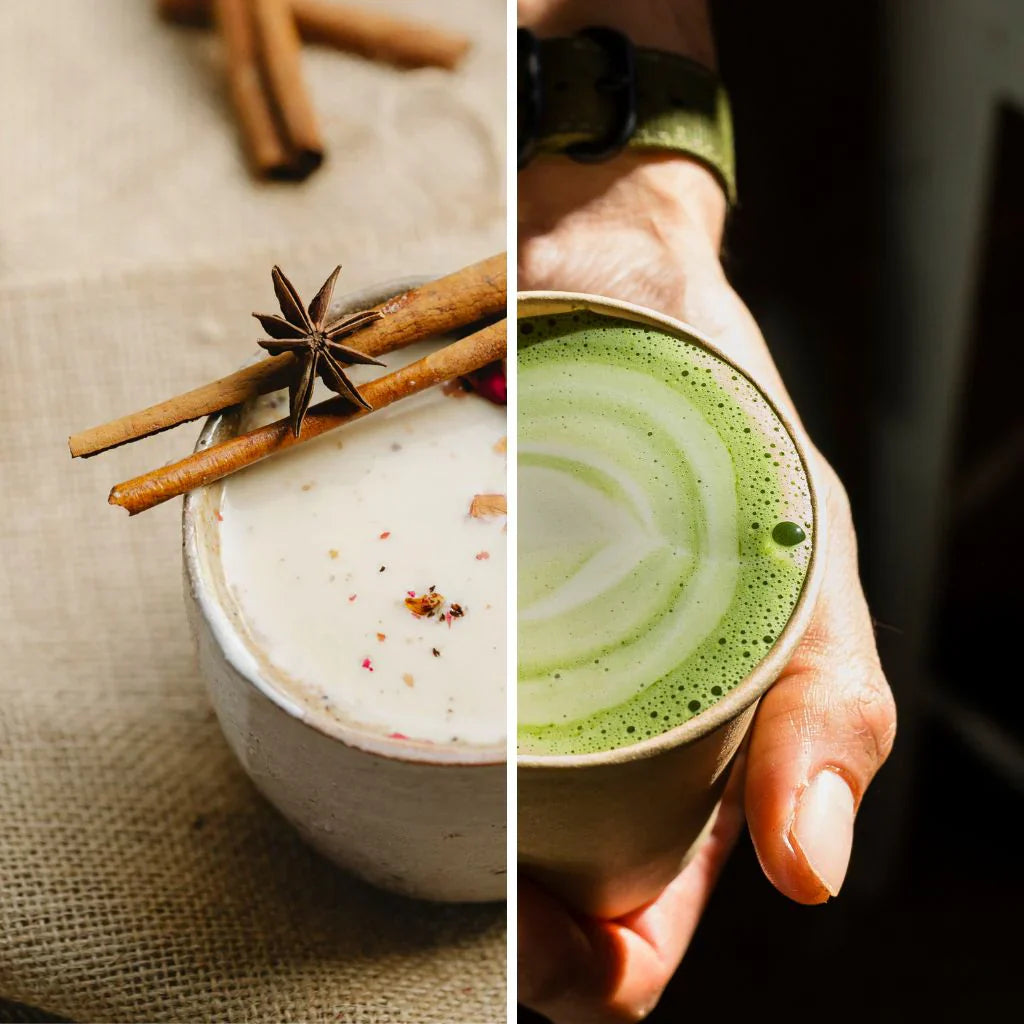
Matcha vs. Chai Latte: Which One Do You Choose?
Reading time: ±7 minutes | Last updated: May 2026
Matcha and chai latte are both popular coffee alternatives, but they are fundamentally different drinks. Matcha is finely ground Japanese green tea powder with an umami-rich flavor and a high concentration of antioxidants. Chai latte is an Indian spiced tea (masala chai) with cinnamon, cardamom, ginger, and cloves, usually prepared with black tea and warm milk. The main difference: matcha contains up to 3 times more antioxidants (EGCG) and offers more stable energy thanks to L-theanine, while chai latte provides a warmer, spicier flavor experience.
In this article, we compare matcha and chai latte across eight points so you can choose which one best suits your goals and taste.
Matcha vs. chai latte: the complete comparison
Quick answer: Matcha wins on caffeine efficiency, antioxidants, calories, and scientific evidence. Chai latte wins on flavor variety, warmth, and the comfort factor. Both are better choices than coffee.
|
Feature |
Matcha latte |
Chai latte |
|
Base |
Green tea powder (Camellia sinensis) |
Black tea + spices (masala chai) |
|
Origin |
Japan |
India |
|
Caffeine per cup |
approx. 64 mg |
approx. 40 to 50 mg |
|
Energy curve |
4 to 6 hours, gradual (L-theanine) |
2 to 3 hours, faster peak |
|
L-theanine |
40 to 60 mg (calm focus) |
0 mg (not present) |
|
EGCG (antioxidant) |
60 to 100 mg |
0 mg (not in black tea) |
|
Calories (with milk, no sugar) |
45 to 55 kcal |
80 to 120 kcal |
|
Sugar (standard cafe version) |
0 g (pure) to 5 g (lightly sweetened) |
15 to 25 g (often standard sweetened) |
|
Flavor profile |
Umami, grassy, creamy |
Spicy, warm, sweet |
|
Color |
Bright green |
Golden brown |
|
Preparation at home |
2 to 3 minutes (whisking) |
5 to 10 minutes (boiling spices) |
|
Price at home per cup |
€0.80 to €1.50 |
€0.30 to €0.80 |
|
Price in cafe per cup |
€5.50 to €6.50 |
€4.00 to €5.50 |
|
Scientific evidence |
Extensive (17,000+ green tea studies) |
Limited (individual spices researched) |
|
Suitable for intermittent fasting |
Yes (pure, no milk) |
No (traditionally with milk) |
Caffeine: matcha provides more and for longer
Quick answer: Matcha contains approximately 64 mg of caffeine per cup, chai latte approximately 40 to 50 mg. But the difference lies in how the caffeine works: matcha offers 4 to 6 hours of calm energy thanks to L-theanine, while chai latte provides 2 to 3 hours with a faster peak.
The caffeine difference seems small (64 mg vs. 40 to 50 mg), but the effect is significantly different. Matcha contains L-theanine, an amino acid that slows the absorption of caffeine and stimulates alpha waves in the brain. The result: calm alertness that lasts for 4 to 6 hours, without the jittery feeling or the crash.
Chai latte completely lacks L-theanine. The caffeine from black tea is absorbed faster, provides a noticeable but short-lived boost (2 to 3 hours), and can cause a slight dip in sensitive individuals as the effect wears off. That is better than coffee (where the crash is sharper), but less stable than matcha.
Want to know more about how caffeine in matcha works? Read how much caffeine is in matcha and what it does to your energy.
Health benefits: matcha has the science
Quick answer: Matcha offers proven benefits via EGCG (heart, skin, fat burning, immune system) and L-theanine (focus, stress reduction). Chai latte offers benefits via individual spices (ginger for digestion, cinnamon for blood sugar), but the evidence is less robust.
This is where matcha has a clear advantage. The health benefits of matcha are supported by thousands of peer-reviewed studies on EGCG, L-theanine, and catechins in green tea. The benefits are measurable: 20% lower risk of cardiovascular disease (Li et al., 2020), 17% higher fat burning (Dulloo et al., 1999), 25% less UV-induced redness (Heinrich et al., 2011).
Chai latte also has health benefits, but they come from the individual spices, not the tea itself. Ginger supports digestion, cinnamon can stabilize blood sugar levels, and cardamom has mild antioxidant properties. The problem: the amounts of spices in an average chai latte are often too small for a significant health effect.
For the full analysis of matcha's health benefits? Read 7 proven health benefits of matcha and EGCG in matcha: the most powerful antioxidant.
Calories and sugar: matcha is the clear winner
Quick answer: A matcha latte with oat milk contains approximately 45 to 55 kcal and 0 grams of added sugar. A chai latte in a cafe contains on average 80 to 120 kcal and 15 to 25 grams of sugar. That is a significant difference for daily consumption.
Here, the difference is most concrete. Matcha is typically prepared without sugar: the powder in water, optionally with unsweetened oat milk. The taste is naturally umami-sweet and does not require extra sweetener.
Chai latte, on the other hand, is traditionally prepared with sugar or honey. In cafes and with instant chai mixes, sugar is a standard ingredient. An average chai latte at a coffee chain contains 15 to 25 grams of sugar per serving, comparable to half a Mars bar. That is about 6 to 10 teaspoons of sugar that you consume without noticing.
If you make chai latte at home with fresh spices and without sugar, the calorie content drops significantly. But most people drink chai latte with sugar, because the spices taste quite sharp and bitter without sweetness.
More about matcha and calories? Read matcha and weight loss: what does science say.
Taste: two completely different experiences
Quick answer: Matcha tastes umami-rich, grassy, and creamy with a soft sweetness. Chai latte tastes warm, spicy, and comfortable with cinnamon, ginger, and cardamom. The choice is purely personal: refined depth vs. cozy warmth.
The flavor profiles of matcha and chai latte are so different that they are hard to compare. It is like comparing sashimi to a curry: both delicious, but fundamentally different.
Matcha latte tastes umami-rich (savory, full), slightly grassy, and creamy. Ceremonial matcha has a soft, natural sweetness without sugar. The flavor is subtle and deep, with a clean finish that leaves your mouth fresh. It is a flavor that you can tolerate early in the morning and that remains pleasant throughout the day.
Chai latte tastes warm, spicy, and comfortable. The cinnamon provides sweetness, the ginger provides sharpness, the cardamom provides floral notes, and the black tea provides body. It is a flavor that evokes associations with cold autumn evenings and thick sweaters. Many people find chai "cozier" than matcha.
The flavor preference is purely personal. There is no objectively "better" taste. However, it is good to know that matcha is more versatile in preparation (pure, latte, iced, smoothie), while chai latte is almost always drunk warm and with milk.
Preparation: matcha is faster, chai is more traditional
Quick answer: You can make a matcha latte in 2 to 3 minutes (sifting, whisking, adding milk). A traditional chai latte takes 5 to 10 minutes (boiling spices, steeping tea, adding milk). Instant chai is faster but lacks the freshness.
Matcha latte at home: sift 2 grams of matcha, add 60 ml of warm water (70 to 80 °C), whisk with a chasen, add warm oat milk. Ready in 2 to 3 minutes. No stove needed, no spices to prepare.
Chai latte at home (traditional): boil water with fresh spices (cinnamon, cardamom, ginger, cloves, black pepper) for 5 minutes. Add black tea and let steep for 3 minutes. Strain, add warm milk and optional honey. Total: 8 to 10 minutes. More steps, more dishes, but also more of a ritual.
Chai latte (instant): pour hot water over a chai mix or syrup and add milk. Fast, but the taste and health benefits are significantly lower than with fresh preparation. Many instant chai mixes contain sugar, maltodextrin, and artificial flavorings.
Price: chai is cheaper, matcha is more valuable
Quick answer: Chai latte is cheaper per cup (€0.30 to €0.80 at home) than matcha latte (€0.80 to €1.50 at home). But matcha provides more active compounds (EGCG, L-theanine, vitamins) per cup and longer-lasting energy.
Per cup, chai latte is the cheaper option. Loose chai spices or a good chai blend cost €5 to €15 per 100 grams and provide dozens of cups. Ceremonial matcha costs €25 to €40 per 30 grams (15 to 30 cups).
However, if you look at what you get in active compounds per cup, the picture changes. One cup of matcha provides 60 to 100 mg of EGCG, 40 to 60 mg of L-theanine, and a spectrum of vitamins. That would cost you much more through supplements. Chai latte mainly provides flavor and comfort, which is also valuable, but in a different way.
When do you choose matcha and when chai?
Quick answer: Matcha for focus, energy, health benefits, and as a daily morning ritual. Chai latte for comfort, cold evenings, variety, and as a social drink.
|
Situation |
Matcha |
Chai latte |
|
Morning focus |
✅ Best choice |
Good but shorter |
|
Workday productivity |
✅ Best choice |
Suitable |
|
Sports / pre-workout |
✅ Best choice |
Less suitable |
|
Weight loss |
✅ Best choice (fewer kcal) |
Less suitable (sugar) |
|
Cold winter evening |
Possible, but less fitting |
✅ Best choice |
|
Social drink |
Suitable |
✅ Best choice |
|
Intermittent fasting |
✅ Best choice (pure) |
Not suitable (milk) |
|
After dinner |
Less common |
✅ Best choice |
|
Budget |
Slightly more expensive per cup |
✅ Cheaper per cup |
More about matcha as a morning ritual? Read matcha morning routine: how to start your day.
Combining matcha and chai: the matcha chai latte
Quick answer: A matcha chai latte combines the antioxidants and L-theanine of matcha with the warmth and spices of chai. It is the best of both worlds, although the flavors sometimes compete with each other.
There is a growing trend to combine matcha and chai in one drink: the matcha chai latte. You first make a matcha shot (2 grams of matcha in 40 ml of warm water), prepare a chai concentrate (spiced tea) separately, and combine both with warm milk.
The result is interesting: the umami of the matcha and the spicy warmth of the chai create a complex flavor profile. Not everyone likes it (the flavors can clash), but for those who appreciate it, it is a unique experience that you see appearing on the menu in more and more cafes in Amsterdam, Utrecht, and Rotterdam.
Matcha vs. chai latte in the Netherlands
Quick answer: In the Dutch hospitality industry, matcha is gaining popularity, while chai latte is an established option. In the Randstad area (Amsterdam, Utrecht, Rotterdam), most specialty cafes offer both.
The Netherlands has a strong tea tradition, and both matcha and chai latte benefit from that. In cities like Amsterdam, Utrecht, Rotterdam, and The Hague, almost all specialty cafes offer both drinks. Matcha is the fastest growing of the two: the search term "matcha" is growing month over month, while "chai latte" remains stable.
Outside the major cities as well, in places like Almere, Zaandam, Hoofddorp, Purmerend, Alphen aan den Rijn, and Schiphol, the availability of matcha is increasing. At Unmatched Matcha, we see orders from all over the Netherlands, with a concentration in the Randstad but a growing share from the rest of the country.
Want to know how our matcha tastes? Ceremonial Unmatched Matcha is served daily at Vonckelend, located at Rokin 81 in Amsterdam. Taste it as a latte or pure and discover which flavor profile you prefer.
Frequently asked questions about matcha vs. chai latte
Is matcha healthier than chai latte?
Yes, if we look at scientific evidence. Matcha contains EGCG (60 to 100 mg per cup), L-theanine (40 to 60 mg), and a broad spectrum of antioxidants with proven effects on the heart, skin, fat burning, and concentration. Chai latte offers health benefits via spices (ginger, cinnamon), but the amounts are often too small for a measurable effect and the evidence is less robust.
Which has more caffeine: matcha or chai latte?
Matcha contains approximately 64 mg of caffeine per cup, while a chai latte contains about 40 to 50 mg. However, matcha's caffeine works more gradually and for a longer duration (4 to 6 hours) thanks to L-theanine, while chai's caffeine peaks faster and works for a shorter duration (2 to 3 hours).
Which has fewer calories: matcha or chai latte?
Matcha latte with oat milk: approximately 45 to 55 kcal. Chai latte in a cafe: approximately 80 to 120 kcal, often with 15 to 25 grams of sugar. Pure matcha (without milk) contains only 2 to 5 kcal. Homemade chai without sugar is comparable to matcha, but most people drink chai with sweetener.
Which is better for weight loss: matcha or chai?
Matcha. It contains fewer calories per cup, zero grams of sugar (pure), and the EGCG stimulates fat burning by approximately 17% during exercise. Most chai latte preparations contain sugar that increases the calorie content. If you drink chai for weight management, prepare it at home without sugar.
Can you combine matcha and chai?
Yes. A matcha chai latte combines the antioxidants of matcha with the spices of chai. Make a matcha shot separately, prepare a chai concentrate, and combine with warm milk. It is a growing trend in specialty cafes in Amsterdam and other cities.
Two worlds, one choice
Matcha and chai latte are both better choices than the average cup of coffee. They offer caffeine in a calmer way, they contain natural ingredients, and they have a ritual that enriches your day. But they are fundamentally different.
If you choose matcha, you choose stable energy, scientifically backed health benefits, and a clean, umami-rich taste. If you choose chai, you choose comfort, warmth, and a spicy flavor adventure. Both are good. But if I have to choose, I go for matcha. Every single morning.
Curious about the matcha side of the story? At Unmatched Matcha, you can order ceremonial matcha from Kagoshima that makes the difference clear in just one sip. Free shipping in the Netherlands on orders over €50.