Everything about matcha: from tea leaf to healthy cup
28-08-2026 · 7 min read
Reading time: 7 minutes | Last updated: January 2027
Matcha is a finely ground green tea powder made from shade-grown tea leaves (Camellia sinensis) and is distinguished from regular green tea by the fact that you consume the entire leaf instead of an infusion. As a result, you ingest all bioactive compounds, including L-theanine, EGCG, and catechins, in concentrations up to 137 times higher than in regular green tea. This makes matcha one of the most nutrient-dense beverages in the world.
What makes matcha different from regular green tea?
The difference is not just in the taste: with matcha, you drink the whole tea leaf, allowing you to ingest up to 10 times more nutrients than with loose-leaf green tea.
With regular green tea, you steep leaves in hot water and then discard them. With matcha, the leaves are steamed, dried, de-stemmed, and then ground between granite stones into an ultra-fine powder (approximately 5 to 10 microns) after the harvest. Because you consume the whole leaf, you absorb all the fiber, chlorophyll, amino acids, and polyphenols in their entirety.
The cultivation is also fundamentally different. At least 20 days before the harvest, the tea plants are covered, so they receive up to 90% less direct sunlight. This shading process increases the L-theanine content by approximately 140% compared to unshaded plants. L-theanine is the amino acid responsible for the calming, focus-enhancing effect of matcha.
Why is the origin so important?
The region determines the flavor profile, amino acid content, and purity of your matcha.
Japan has several tea regions, but Kagoshima (on the southern island of Kyushu) is the largest matcha-producing prefecture in the country and now provides more than 30% of Japanese tea production. Its proximity to the active volcano Sakurajima ensures mineral-rich volcanic soil. In combination with the subtropical climate, this produces tea leaves with a remarkably soft, creamy umami profile without the sharp bitterness that you might experience from some other regions.
Uji (near Kyoto) is historically the most famous matcha region, but Kagoshima is gaining ground in terms of production volume and price-quality ratio. The lower elevation and longer growing period in Kagoshima give the leaves more time to build up amino acids. Want to know more about this difference? Read our comprehensive comparison between Kagoshima and Uji matcha.
Single origin and first harvest
Not all matcha is created equal. Ceremonial matcha from the first harvest (ichibancha, usually April/May) contains the highest concentration of L-theanine and the lowest concentration of bitter compounds. Later harvests (nibancha, sanbancha) are often used for culinary-grade matcha. At Unmatched Matcha, we work exclusively with ichibancha from Kagoshima: organic, single origin, and without additives.
Health benefits of matcha: what does science say?
Matcha is rich in catechins (especially EGCG), L-theanine, and chlorophyll, with proven effects on, among other things, antioxidant status, cognition, and metabolism.
Antioxidants and EGCG
The most researched polyphenol in matcha is epigallocatechin gallate (EGCG). One serving of matcha (approx. 2 grams) contains about 60 to 70 mg of EGCG. A systematic review from 2020 concluded that regular intake of green tea catechins is associated with a reduced risk of cardiovascular disease and an improved antioxidant status in the blood.
The ORAC value (Oxygen Radical Absorbance Capacity) of matcha is around 1,384 µmol TE per gram. For comparison: blueberries score approximately 93 µmol TE per gram, nearly 15 times lower.
Focus and relaxation through L-theanine
L-theanine stimulates the production of alpha waves in the brain, a state associated with alert relaxation. A study published in Nutritional Neuroscience (2019) showed that 200 mg of L-theanine improved reaction speed and reduced stress-related symptoms in subjects under cognitive load. A cup of matcha contains about 30 to 50 mg of L-theanine, depending on the quality. Because L-theanine slows down the absorption of caffeine, you experience a steady sense of energy for 4 to 6 hours, without the peaks and crashes that can occur with coffee. Curious about the full difference? Read our in-depth comparison of matcha vs. coffee.
Metabolism and weight management
Research published in The American Journal of Clinical Nutrition (Hursel et al., 2009) showed that green tea extracts increased fat burning during moderate exercise by an average of 17%. Although matcha is not a miracle cure for weight loss, as part of a healthy diet, it can support metabolism.
What matcha cannot do
Honesty is important. Matcha is not a medicine and never replaces medical advice. Most studies have been conducted with isolated extracts in higher dosages than what you get in a daily cup of matcha. Effects on cancer prevention, for example, are promising in cell studies but have not yet been convincingly proven in large-scale clinical trials. Always consult your doctor if you have any health concerns.
Comparison: matcha vs. coffee vs. green tea
| Matcha (2 g) | Filter coffee (200 ml) | Green tea (200 ml) | |
|---|---|---|---|
| Caffeine | 60-70 mg | 80-120 mg | 25-40 mg |
| L-theanine | 30-50 mg | 0 mg | 5-8 mg |
| EGCG | 60-70 mg | 0 mg | 5-10 mg |
| Energy duration | 4-6 hours | 1-3 hours | 2-3 hours |
| Calories | ~5 kcal | ~2 kcal | ~1 kcal |
Preparation: how do you make the perfect cup of matcha?
Proper preparation is the difference between a creamy, umami-rich cup and a bitter disappointment.
Use 1.5 to 2 grams of matcha (about one level chashaku, or half a teaspoon). Heat water to 70 to 80 degrees Celsius (never boiling, as that burns the delicate amino acids and makes your matcha unnecessarily bitter). Pour 70 to 80 ml of water over the powder and whisk firmly with a chasen (bamboo whisk) or electric frother in a W or M motion until a fine, airy foam layer forms.
A tip that few brands tell you: let your matcha stand for 10 to 15 seconds after whisking before you drink. The foam stabilizes and the taste becomes slightly rounder. This is a technique that Japanese tea masters use during temae (tea ceremony).
How to recognize good matcha?
The color, smell, and origin tell you almost everything about the quality.
- Color: bright green to deep jade green. Yellow-green or brownish indicates lower quality or oxidation.
- Smell: fresh, slightly sweet, with grassy and umami notes. Musty or flat? Probably old or poorly stored.
- Texture: silky smooth, without grains. Good stone milling produces particles of 5 to 10 microns.
- Origin: Japanese single origin (Kagoshima, Uji, Nishio) offers the best traceability.
- Certification: organic (JAS/EU Bio) is an extra quality guarantee.
Want to learn more about recognizing quality? Read our article on how to recognize good matcha.
Storage and shelf life
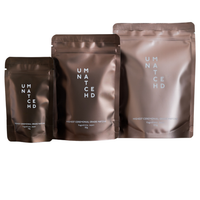
Unopened, ceremonial matcha lasts 12 to 24 months. Store it airtight, cool, and dark (the refrigerator is fine, but let the bag reach room temperature before opening to prevent condensation). After opening, it is best to use the matcha within 4 to 6 weeks for optimal freshness. Unmatched Matcha delivers in airtight bags of 30g, 50g, or 100g, not jars.
Trying matcha: where to begin?
A 30g bag is enough for 15 to 20 cups and is the ideal way to discover ceremonial matcha.
If you are curious about what real ceremonial first-harvest matcha tastes like, we recommend starting small. The 30g ceremonial matcha from Unmatched Matcha is our bestseller and perfect for beginners. Use the code UNMATCHED15 for 15% off your first order. Free shipping from €50.
Prefer to taste it first? In Amsterdam, you can visit Vonckelend (Rokin 81), the only physical retail location where you can try Unmatched Matcha.
Frequently asked questions
How much matcha can you drink per day?
Most sources recommend 1 to 3 cups per day (1.5 to 2 grams per cup). That amounts to a maximum of 4 to 6 grams of matcha. At this amount, you stay well below the maximum daily caffeine intake of 400 mg recommended by health authorities for adults. Pregnant women and people with caffeine sensitivity should consult their doctor.
Is matcha better than coffee?
Matcha and coffee both contain caffeine, but matcha also contains L-theanine, which slows caffeine absorption and provides a calmer sense of energy. Whether matcha is "better" depends on your personal preference and sensitivity. Many coffee switchers choose matcha because of the lack of crashes and better digestion.
What is the difference between ceremonial and culinary matcha?
Ceremonial matcha is made from the youngest leaves of the first harvest and is intended for drinking straight. Culinary matcha comes from later harvests, tastes more bitter, and is suitable for recipes such as lattes and baked goods. Read more in our article on the difference between ceremonial and culinary matcha.
Why is matcha so expensive?
The shading process, the manual harvest of only the youngest leaves, and the slow grinding process (a stone mill produces only 30 to 40 grams per hour) make production labor-intensive. Additionally, ichibancha (first harvest) is only available once a year, which limits supply.
Can you drink matcha on an empty stomach?
Matcha can be drunk on an empty stomach, but some people experience slight nausea due to the catechins. A small breakfast or a few nuts beforehand helps. If you have a sensitive stomach, we recommend making the matcha slightly less concentrated (using 100 ml of water instead of 70 ml).