Why is matcha so expensive? The honest explanation
04-05-2026 · 12 min read
Why Is Matcha So Expensive? The Honest Explanation
Reading time: ±7 minutes | Last updated: May 2026
Matcha costs more than regular green tea, coffee, or tea bags, and there are six concrete reasons for this. The labor-intensive production process (shading, manual selection, stone grinding) explains why ceremonial matcha costs €25 to €40 per 30 grams. However, if you calculate it per cup, you arrive at €0.80 to €1.50 per serving, less than a cup of specialty coffee and a fraction of a matcha latte in a café.
In this article, we will show you exactly which steps determine the price, what the difference is between cheap and expensive matcha, and why matcha is actually quite affordable when calculated by the gram of active ingredients. No sales pitch, just the honest explanation.
The 6 reasons why matcha costs more
Quick answer: Matcha is expensive because of the shading process (3 to 4 weeks of extra labor), the selection of only the youngest leaves, the removal of stems and veins, slow grinding in granite mills, the limited production per mill, and Japanese labor costs.
1. Shading: 3 to 4 weeks of extra labor
Before the harvest begins, the tea plants are covered for 20 to 30 days with dark nets or bamboo screens. These nets must be installed, monitored, and removed after the harvest. On large plantations, this is weeks of work for multiple laborers. Regular green tea skips this step, which directly saves on labor costs.
The shading process is not optional. Without shading, the plant does not produce extra L-theanine and chlorophyll, and the result is not matcha but simply green tea powder. It is this step that gives matcha its mellow umami flavor, vibrant green color, and high concentration of active compounds.
2. Selective harvest: only the youngest top leaves
For ceremonial matcha, only the very first, youngest top leaves of the first harvest (ichiban-cha) are used. These leaves are the most tender, contain the most amino acids, and provide the mildest flavor. Older, larger leaves are kept separate for culinary grade or lower qualities.
The selectivity of the harvest has a direct impact on yield. Only a small percentage of total tea production in Japan qualifies for ceremonial matcha. With regular green tea, all leaves are used, which makes the yield per hectare significantly higher.
3. De-veining: 40 to 50% of the leaf is lost
After steaming and drying, the leaves are stripped of stems and veins. This process is called tencha production. The stems and veins contain less flavor and give the powder a rough texture. By removing them, the matcha becomes finer and smoother.
The downside: during de-veining, 40 to 50% of the leaf material is lost. What remains is pure leaf tissue (tencha), the raw material that is ground into matcha. You are therefore paying for the half of the leaf that is discarded, and that is a significant cost factor.
4. Stone grinding: 30 to 40 grams per hour per mill
The tencha is ground in granite stone mills (ishi-usu). This is the slowest part of the entire process. One mill produces only 30 to 40 grams of matcha per hour. That is less than one standard package per hour.
The slow grinding is not an inefficiency; it is a conscious choice. Faster (mechanical) grinding causes friction heat that damages the flavor compounds, EGCG, and L-theanine. The granite mill keeps the temperature low and produces an ultra-fine powder of 5 to 10 microns, finer than most cosmetic powders.
For comparison: a mechanical mill produces hundreds of grams per hour, but yields a coarser product with less flavor and nutritional value. The price of matcha therefore directly reflects the quality of the grinding.
5. Japanese labor costs and craftsmanship
The best matcha is produced in Japan, a country with high labor costs and strict quality standards. Japanese tea farmers are often artisans who have worked the same fields for generations. Their expertise in shading, harvest timing, and processing cannot be replicated with cheap labor elsewhere.
Chinese matcha is cheaper, but the production process is often simplified: shorter or no shading, mechanical grinding, and less strict selection. The result is a product that looks similar but tastes different and contains fewer active ingredients.
6. Limited production: demand exceeds supply
The global demand for matcha is growing by approximately 12% per year (Euromonitor, 2024), while production capacity in Japan does not scale at the same rate. New tea plantations take years before they produce ceremonial quality. The result: the price is partly determined by scarcity.
This also explains why ceremonial matcha is more expensive than culinary grade. The production of ceremonial requires more labor, stricter selection, and slower grinding, while demand is growing fastest in the premium segment.
What does matcha cost per cup? The honest calculation
Quick answer: A cup of ceremonial matcha costs €0.80 to €1.50 at home. That is cheaper than specialty coffee (€1.50 to €3.00), an energy drink (€1.50 to €2.50), and a matcha latte in a café (€5.50 to €6.50).
|
Drink |
Price per cup (at home) |
Price per cup (café) |
Calories |
|
Ceremonial matcha |
€0.80 to €1.50 |
€5.50 to €6.50 |
2 to 5 kcal |
|
Culinary matcha latte |
€0.40 to €0.80 |
€4.50 to €5.50 |
40 to 80 kcal (with milk) |
|
Specialty coffee (filter) |
€0.30 to €0.60 |
€3.00 to €4.50 |
2 kcal |
|
Specialty coffee (latte) |
€0.50 to €1.00 |
€4.00 to €5.50 |
120 to 180 kcal |
|
Energy drink |
€1.50 to €2.50 |
n/a |
100 to 200 kcal |
|
Green tea (loose leaf) |
€0.10 to €0.30 |
€2.50 to €3.50 |
1 to 2 kcal |
|
Tea bag |
€0.05 to €0.15 |
€2.00 to €3.00 |
1 kcal |
The calculation is clear. Ceremonial matcha costs about the same per cup as specialty coffee and is 3 to 5 times cheaper than a matcha latte in an Amsterdam café. If you drink matcha daily and were to do so in a café, you would pay approximately €150 to €200 per month. At home, it costs €25 to €45 per month. That is a saving of more than €100 per month.
More about making matcha latte at home? Read matcha with oat milk: why this is the best combo.
Price per gram of active ingredients: matcha is actually cheap
Quick answer: If you compare matcha to other sources of the same active ingredients (EGCG, L-theanine), matcha is cheaper per milligram of active ingredient than most supplements and superfoods.
Another way to look at the price: what do you get in active ingredients per euro?
|
Source |
EGCG per serving |
Cost per serving |
EGCG per euro |
|
Ceremonial matcha (2g) |
60 to 100 mg |
€0.80 to €1.50 |
67 to 125 mg per euro |
|
Green tea (1 cup) |
20 to 35 mg |
€0.10 to €0.30 |
70 to 350 mg per euro |
|
EGCG supplement (capsule) |
200 to 400 mg |
€0.30 to €0.60 |
333 to 1333 mg per euro |
|
Matcha latte in café |
60 to 100 mg |
€5.50 to €6.50 |
9 to 18 mg per euro |
EGCG supplements are cheaper per milligram but miss the L-theanine, vitamins, chlorophyll, and the complete matrix of bioactive compounds that matcha offers. Green tea is comparable per milligram, but you need 3 to 5 cups for the same amount of EGCG as 1 cup of matcha. And a matcha latte in a café? That is by far the most expensive way to get EGCG.
More about EGCG and the benefits? Read EGCG in matcha: the most powerful antioxidant explained.
Cheap vs. expensive matcha: what is the difference?
Quick answer: Cheap matcha (under €15/30g) is almost always culinary grade, harvested later, shaded for a shorter period, and mechanically ground. Expensive matcha (€25 to €40/30g) is ceremonial, first harvest, shaded longer, and stone-ground. You can taste, smell, and see the difference immediately.
|
Property |
Cheap matcha (< €15/30g) |
Ceremonial matcha (€25 to €40/30g) |
|
Harvest |
Second or third harvest |
First harvest (ichiban-cha) |
|
Shading |
Short or none |
20 to 30 days |
|
Grinding |
Mechanical |
Granite stone mill |
|
Color |
Dull yellow-green |
Vibrant jade green |
|
Taste |
Bitter, flat |
Umami-rich, smooth, sweet |
|
EGCG per gram |
15 to 30 mg |
30 to 50 mg |
|
L-theanine per gram |
8 to 15 mg |
20 to 30 mg |
|
Texture |
Coarse, sometimes sandy |
Ultra-fine, silky smooth |
|
Best use |
Baking, smoothies |
Drinking pure, latte |
The conclusion: cheap matcha is not "matcha for less money." It is a different product, with a different taste, different nutritional value, and a different purpose. If you want to drink matcha (pure or as a latte), ceremonial quality is the only option that provides a good experience. If you want to use matcha for baking, culinary is the smart choice.
The full difference? Read ceremonial vs culinary matcha: what is the difference and which one do you choose.
Is matcha more expensive than coffee?
Quick answer: Per cup, ceremonial matcha is comparable to specialty coffee (€0.80 to €1.50 vs €0.30 to €1.00). But matcha offers more active ingredients (EGCG, L-theanine) per serving, and the energy lasts longer (4 to 6 hours vs 1 to 2 hours), so you need fewer cups.
The comparison with coffee is the most frequently asked. Let's be honest: per cup, matcha is slightly more expensive than average coffee, but comparable to specialty coffee.
The difference lies in what you get per cup. One cup of matcha provides 4 to 6 hours of stable energy, while coffee gives 1 to 2 hours followed by a crash. Many coffee drinkers need 3 cups per day (total €0.90 to €3.00), while 2 cups of matcha are sufficient (total €1.60 to €3.00). Per day, you arrive at a similar amount, but matcha also offers 120 to 200 mg of EGCG, 80 to 120 mg of L-theanine, and a range of vitamins that coffee does not contain.
The full comparison can be found in matcha vs coffee: what is better for energy and focus.
5 tips to keep matcha affordable
Quick answer: Buy larger packages, make it at home instead of in a café, use the right amount (1 to 2 grams per cup), store it properly, and choose ceremonial for drinking and culinary for baking.
Tip 1: Buy the larger package. The 100g package is more economical per gram than the 30g. If you know you drink matcha daily, you will save in the long run.
Tip 2: Make matcha at home. A matcha latte at home costs €1.30 to €1.80. In a café, you pay €5.50 to €6.50. With daily use, you save more than €100 per month.
Tip 3: Use the right amount. 1 to 2 grams per cup is sufficient. Using more does not make the matcha better; it wastes powder and makes the taste overwhelming.
Tip 4: Store matcha properly. After opening, store your matcha airtight in the refrigerator. Improper storage causes oxidation, which reduces color, flavor, and nutritional value. Proper storage means less waste.
Tip 5: Use ceremonial for drinking, culinary for baking. Don't try to save money by drinking culinary grade pure (it tastes bitter), but save by using culinary in recipes where ceremonial is overkill.
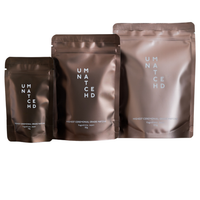
More about storing matcha and maintaining quality? We will cover that in a future article. Want to get started now? Take a look at the Unmatched Matcha range and choose the packaging that suits you.
What does Unmatched Matcha cost?
Quick answer: Ceremonial matcha from Unmatched Matcha is available in 30g, 50g, and 100g. The price per cup varies from approximately €0.80 to €1.50, depending on the packaging size and the amount per serving.
Unmatched Matcha is ceremonial grade from the Kagoshima region in Japan. First harvest, shade-grown, stone-ground, with no additives. Founded by Dominique and Benck, who tested the matcha for nine months in Dominique's shop before launching.
We are transparent about pricing. Ceremonial matcha is not a budget product. But it is a conscious investment in quality, taste, and health that is more economical per cup than most alternatives. Free shipping in the Netherlands on orders over €50.
Whether you live in Amsterdam, De Pijp, the Bijlmer, Almere, Zaandam, Utrecht, or anywhere else in the Netherlands: your order will be delivered the next working day.
→ View the range and calculate your price per cup
Frequently asked questions about the price of matcha
Why is matcha so expensive?
The price of matcha is determined by six factors: 3 to 4 weeks of shading, selective harvest of only the youngest leaves, removal of stems and veins (40 to 50% is lost), slow grinding in granite mills (30 to 40 grams per hour), Japanese labor costs, and limited production capacity versus growing demand.
How much does a cup of matcha cost?
At home, a cup of ceremonial matcha costs approximately €0.80 to €1.50. In a cafe, you pay €5.50 to €6.50 for a matcha latte. Making matcha at home is 3 to 5 times cheaper than in a cafe.
Is expensive matcha better than cheap matcha?
Usually yes, but not always. The price correlates with quality factors such as harvest, shading, and grinding. Ceremonial matcha (€25 to €40 per 30g) is almost always better than matcha under €15 per 30g. However, there are also expensive brands that are mostly selling marketing. Always judge by color, taste, and origin, not just price.
Why does ceremonial matcha cost more than culinary?
Ceremonial matcha is made from the first harvest (rarer), shaded for longer (more labor), strictly selected (more loss), and ground in granite mills (slower). Culinary matcha comes from later harvests, is shaded for a shorter time, and is often machine-ground. The difference in production costs is directly reflected in the price.
Is matcha more expensive than coffee?
Per cup, ceremonial matcha (€0.80 to €1.50) is comparable to specialty coffee. However, matcha offers more active ingredients and longer-lasting energy per cup (4 to 6 hours vs 1 to 2 hours), meaning you need fewer cups. Per day, the costs work out to a similar amount.
The price tells the story
Matcha is not expensive for the sake of being expensive. Every cent in the price represents a step in the production process that cannot be skipped without compromising quality. The shading, the selection, the de-stemming, the slow grinding: skip any of those steps and you no longer have matcha, but a cheaper product that tastes different, looks different, and does less for you.
What convinced me that matcha is worth the money was not the price per gram, but the price per experience. Two minutes of whisking matcha every morning, that first sip of gentle umami, 4 hours of stable focus, better sleep at night. That is what €1.00 a day gives you. Compare that to what you spend on coffee, energy drinks, or supplements that do less.
Try it for yourself. At Unmatched Matcha you order ceremonial matcha from Kagoshima that is worth every cent. Start with the 30g package and judge for yourself after your first cup. Free shipping in the Netherlands on orders over €50.